The Nonprofit Industrial Complex
Its not perfect, but its what we have


There are many criticisms of nonprofits (or community-based organizations, if you prefer), both in how they are structured and their resulting effectiveness. Many of those criticisms may be valid, but they also miss the point. Here I want to summarize the claims as I hear them, steel man, and then answer them. Most criticisms of nonprofit groups fall largely into two categories: inefficiency and ineffectiveness.
Nonprofits Are Ineffective
The logic goes: nonprofits say their goal is to do X, but they have been working for a long time and X has not yet been accomplished, therefore nonprofits must be a bad way to accomplish X. (In this case, X being the social ill that most annoys the criticizer.) This logic can manifest broadly as an aspersion at the societal level, or narrowly, in which the criticism is cast upon a specific nonprofit and its particular mission, i.e., The homeless shelter has been asking for money and promising to end homelessness for years. I give every month, yet I still see people sleeping on the street.
These critical claims can be hard to answer because they are partially true. Some nonprofits are ineffective. Others overpromise in their fundraising communications. I personally suspect that some of the most operationally effective nonprofits are also the most prone to overpromising because they tend to be led by people who make big promises but also work hard to keep them. Just like among businesses there is an uneven distribution of operational efficiency among nonprofit organizations, and improving the efficiency of each individual organization is yeoman’s work.
In the same way that human resources, facility management, communications, and many other operational concerns impact cost-effectiveness in other types of business, these factors are also important but non-central parts of what it takes for a nonprofit to be successful. And like with organizations of any type, effectiveness in these areas can widely vary. Much like a plumbing business or a dental practice though, a nonprofit also has a core competency that it must deliver in addition to regular fiscal management. What differentiates nonprofits further still from the plumber or the dentist, however, is that their revenue is frustratingly disconnected from their own core competency. If a plumber wants more money, she does more plumbing and does it well. If a dentist wants more money, they clean more teeth and clean them well. But if a housing organization were to attempt to solve its budget challenges by trying to provide more housing, it would go out of business. No matter how much a nonprofit might want to provide or how well they are providing it, the costs flow from activity in a nonprofit remains wholly separate from its revenue. For most nonprofits, raising the revenue—whether at fundraising events, via donor development, through grants, or some combination of all three—becomes one of those pesky non-central capabilities they must also master.
Imagine a plumber whose passion is to fix pipes, but who must convince people with no pipe problems to fund the pipe repair in somebody else’s house. This is a closer parallel to what the average nonprofit achieves. To stretch this metaphor even further, imagine the public calling this plumber ineffective because she’s still out asking for money year–after-year. She might be ineffective, but the ask alone is not evidence of that. It is evidence, instead, that there are always more pipes to fix, and she needs funding to do that. Those facts are entirely beside the point of whether she is any good at providing the service she provides.
Nonprofits Are Inefficient
Some people tend to criticize bigness generally, as if large organizations are inefficient by their very nature. Again: not untrue. Large organizations have more structures, more places for inefficiency to accumulate. On average, it is correct that large organizations tend to be inefficient, but in a different way, they are also more efficient. Institutional memory and capacity, for example, allow some organizations to just do things, which other smaller organizations would likely need to learn how to do, taking up both time and money. Large organizations have more efficiencies and more inefficiencies; they have more of everything. It’s right there in the name. The type of inefficiencies in large organizations and small organizations, however, have different characters and therefore different solutions. In many cases, it’s simply a matter of scale.
For the purpose of illustration, let’s oversimplify. Assume each employee is expected (and compensated) to produce 40 productivity units (Pu) /week, 180 /month, and 2,000 /year (assuming two weeks of paid vacation). Therefore, an employee who starts work 30 minutes late and stops 30 minutes early would only produce 1,750 Pu /year, a loss of 45 days’ worth of Pu each year. If everyone in the organization behaved exactly the same, then comparing an organization with a staff of 2 to an organization with a staff of 200, the difference in lost productivity from a leak like this becomes 500 Pu versus 50,000 Pu. This is an obvious increase in inefficiency, but which organization is more impacted by the change?
I sense that critics of inefficiency mean something different though— that leaks of this type are more common in large organizations. In other words, large organizations tend to have more employees who are producing fewer than expected Pu, while the two-person org is likely staffed by two people who consistently over-perform their expected-Pu.
I have not found that to be true for two reasons.
First, large organizations benefit from economies of scale. They leverage their scale to negotiate better deals on things like health insurance, meaning that even when all else is equal, compensation tends to be better at large organizations, allowing them to gradually accumulate employees who over-perform typically because of greater experience in the field. An ordinary nonprofit professional career arc moves incrementally from small to large organizations. Second, not all Pu are created equal. Imagine two kinds of tasks—blue and red—that each require separate skills, education/training, and experience. A two-person organization likely employs one red-skilled employee and one blue. If one of them is sick or on vacation, the work stops until they return. Perhaps the small organization cross-trains, converting its one red and one blue into two purple employees; but purple employees expect higher pay as warranted by their greater skill versatility. So, a small organization, just to keep the work moving despite the occasional head cold and/or camping trip, will pay a 10-15% premium for labor.
But at the large organization, there is likely much more task diversity. Rather than two, there are fifteen task types, and at least four employees trained to do each of them. The Pu keep rolling even with 20% of the workforce away from the job simultaneously. There is greater opportunity to cross train at little to no cost and less need to pay a premium for the resulting skill diversity. And the greater task diversity and deeper team allows more specialized employees to thrive at a larger organization in ways that they could not in a smaller one.
I lead an organization which employs around 25 people, which is approaching mid-sized as nonprofits go. Instead of an HR director, comptroller, and facilities manager, we have an operations director. Instead of a photographer, designer, and social media intern, we have a communications coordinator. Small organizations hire generalists; large organizations hire specialists.
Everybody has a pet-peeve inefficiency—whether wage theft, skill-task misalignment, or something else—but each of these leaks is easier for a large organization to overcome than a small organization.
What frustrates me about these criticisms of nonprofits is not that they’re wrong, but that they’re only partially correct—at least some of the time—while completely missing the point. Efficiency and effectiveness are subjects that I, a leader of a mid-sized nonprofit, must earn the right to think about by succeeding in the actual most important part of my job: alignment.
Nonprofit Success Is Alignment
The structural difference between nonprofit and for-profit organizations is the ownership. A for-profit organization is owned by its shareholders, whether a single individual, a family, or a group of investors. The profit interest of the ownership ultimately drives a for-profit organization’s strategic decision-making. A nonprofit, by contrast, is owned by the community, and the community’s interest is represented by a board of directors. But “the community’s interest” is much more subjective than capitalistic profit. What is the community’s interest? Who gets to say? Nonprofit boards tend to turnover completely every 3–5 years, much more frequently than the average for-profit organization will be bought/sold, so a definition of community interest, insofar as a nonprofit board is able to settle on one, might be completely rewritten by the next board repeatedly every 3–5 years.
Additionally, there are many other participants in a nonprofit—staff, volunteers, donors, clients, regulators, the key leader—who may all have a different idea of what is in the community’s interest. A sophisticated board will have methods of drawing this input into its decision-making. Most nonprofit boards, however, are not very sophisticated, meaning at best they ask around a bit before making decisions. This is the hardest part of nonprofit leadership: keeping the governance connected enough to make informed decisions but not so close as to be meddling in work that is not and should not be theirs.
Okay, so who are the participants?
Donors / Funders—Remember those important but non-core organizational activities and how, for nonprofits, revenue generation might be one of them? Well, the people who provide that money have opinions. To keep the money flowing, nonprofit leaders do more than just listen to those opinions; they work to shape them. I think of donors (individuals who make charitable gifts) and funders (institutions who issue grant funding) as exerting mostly the same kind of influence on the nonprofit landscape.
Regulators / Contracting Agencies—Sometimes a nonprofit organization is doing work regulated and/or contracted by a government agency which may have an opinion on what the community needs and which may use its leverage to push the nonprofit(s) to align to its priorities.
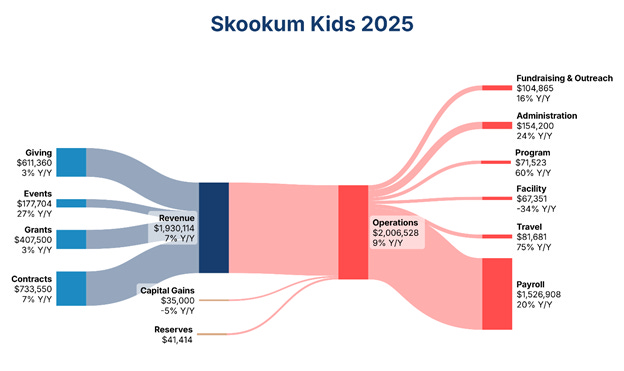
The organization I lead is a child-welfare nonprofit, meaning we work in and around foster care that is regulated and partially funded by an agency of state government. But only approximately a third of our funding comes to us through these contracts. The rest we go out and raise from donors and funders in the community. This creates a situation where the “minority” shareholder (state government) has more direct control over the programming and operations of the organization than the “majority” shareholders who are contributing two dollars to every one the state puts into the endeavor. This disparity distorts the incentives in some strange ways, and it takes a lot of work to maintain enough alignment between these two bodies to keep the organization effective and functional.
By way of example, the organization I lead—a child welfare agency which holds five contracts with the State of Washington for a range of programs—raised more in philanthropy than it did in contracted revenue last year.
Staff—The people in the trenches every day, doing the work that advances the nonprofit’s mission, often have a unique and valuable view on community needs. If that view is not sought-out, respected, and incorporated into strategic decision-making, an organization can quickly become out of step with community needs. Nonprofit leaders run the risk of alienating the staff even without committing any major strategic errors. Doing difficult work, often for compensation that is at or below the going market rate for their skills, staff investment in the mission and belief in the organization’s leadership is essential. Ignoring or failing to ask for their expertise is the fastest way to compromise it. Yet while staff have a unique view, they also may not have a complete one. So, much like with donors and funders, nonprofit leadership must invest considerable care and effort to cultivate and shape staff understanding of the context that the organization is working within and the reasoning behind leadership decisions.
Board—The strategic choices of the nonprofit organization are made by a board, comprised of volunteers, who represent the community’s interests. Very rarely are individual board members nonprofit experts. Most often they are highly engaged financial supporters who are recruited to the board for their interest and alignment to the cause. But as with staff, board alignment can degrade quickly. Especially in moments of crisis, when decisions—out of necessity—are made quickly, a board can feel left behind or usurped by the organization’s leadership. Alignment, especially amongst these three groups—staff, leadership, and board—takes much effort to build and can be potentially destroyed by a single misstep.
Misalignment amongst these groups is the most common organization killer and my personal inefficiency pet-peeve. Imagine:
· A board motivated to grow the organization with a staff that is burnt out.
· A regulator pushing an organization off a funder’s favorite program type.
· A staff who feels compelled to express solidarity and a board and/or donor who disagrees.
The most important role of an organization’s key leader(s) is to achieve and preserve alignment—and it’s a lot of work. Because of this, I am sympathetic to those who suggest that the entire nonprofit system is a mistake.
So, why not just burn it down and start over?
The nonprofit system has paternalistic origins, includes all this extraneous complexity, and satisfies few of us with its outcomes. So, the reasoning goes, would we be better off dismantling the nonprofit system we have now and starting fresh?
To that I would say: Good luck. Systems, especially big and complex ones, have a self-preservation instinct. They fight back. You might believe that it’s a fight worth having. And while I would buy a ticket to watch, but it’s not my fight. I can understand why others might choose to take on nonprofit reform as their life’s work, but my life’s work is to improve my community. Building/leading a nonprofit, even with all its baggage, has more leverage in that goal than attempting to reform all nonprofits. It’s a matter of success odds.
To this, and many other large-scale reforms, there is a massive collective action problem. The alignment challenge is a product of the sheer number of people who participate in this system, many of whom quite enjoy and are effective in their roles and some of whom derive some sense of identity from their roles as well. That ends up comprising a lot of people with a potent incentive to resist reform of any meaningful depth out of a reasonable suspicion that it would hamper their ability to continue doing the work they love. Depending on how you look at it, the number of people who participate in nonprofits is either a feature or a bug. In one sense, that is a lot of cooks in the kitchen. In another sense, that is a lot of invested participants.
I do not like the success odds for a revolution of all nonprofit structures. I can imagine much talent and passion being crushed against those rocks before any of them give way. Or perhaps more to the point, a lot of talent and passion rising to defend their ability to keep working in the way they know with the inefficiencies they have learned to manage.
So rather than waste my shot, I choose to live with the inefficiency. I strive after the positive change I can make in the community in which I live and devote my efforts towards promoting alignment among all those fighting on my side. And I have managed to accomplish some big things while doing so.